Showing posts with label World Variety Bridges. Show all posts

Saturday, 10 October 2015

Linn Cove Viaduct: The Most Environment Friendly Bridge

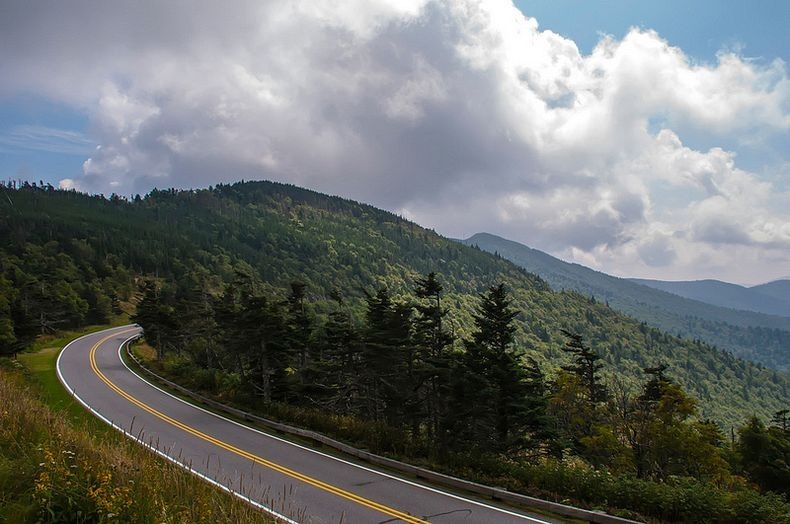
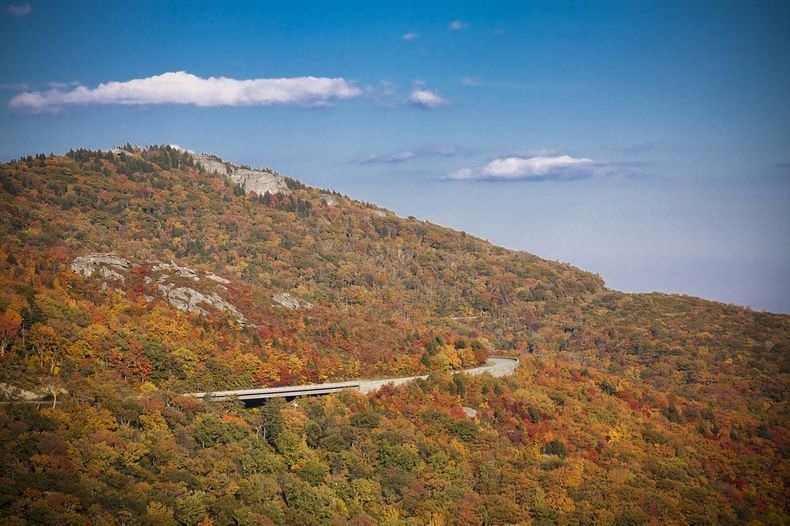
Linn Cove Viaduct is a 379 meter concrete segmental bridge which snakes around the slopes of Grandfather Mountain in North Carolina. Completed in 1987, at a cost of $10 million, it was the last section of the Blue Ridge Parkway to be finished, and considered to be one of the most challenging bridge construction.
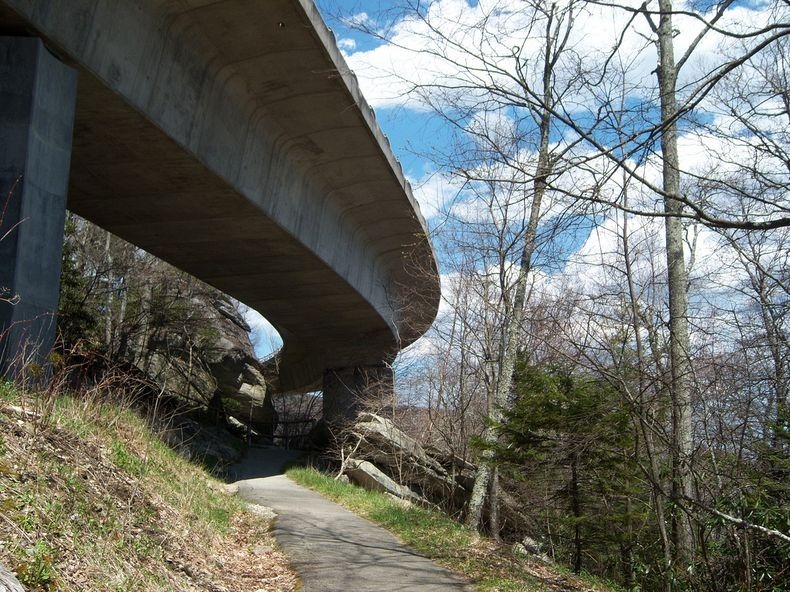
The viaduct was built to minimize the damage that a traditional cut-and-fill road would have caused to Grandfather Mountain. Supported by seven massive pillars, the viaduct almost floats in the air without disturbing the land below. To eliminate damage to the environment, no access roads were built for transporting heavy equipment on the ground. The bridge's segments were precast at an indoor facility and transported to the bridge site, where each section was lowered into place by a custom crane placed on either edge of the existing structure. The only construction that occurred at ground level was the drilling of foundations for the seven permanent piers on which the Viaduct rests. Exposed rock was covered to prevent staining from concrete, epoxy, or grout. The only trees cut were those directly beneath the superstructure.
linn-cove-viaduct-14
When engineers began constructing the Blue Ridge Parkway in 1935, they knew that building the Parkway that fit the terrain, particularly the Black Rock area of Grandfather Mountain, would be tricky. The whole area consisted of one large mass of boulders, cracked and loose, so conventional road-building practices would not have worked.
A key factor in this controversy was environmental concern. Engineers were faced with a serious question: How to build a road at an elevation of 4,100 feet without damaging one of the world’s oldest mountains? Studies and engineering schemes were done through the early 1970s in search of a plan for routing the Parkway through that area. Finally, the National Park Service landscape architects and Federal Highway Administration engineers agreed the road should be elevated or bridged, where possible, to eliminate massive cuts and fills.
The Linn Cove Viaduct is only the second bridge in history to be built from the end of a span, called a cantilever, which is anchored only at one end. In this case, the cantilever was the road itself. To protect the fragile terrain, all construction was done from the top down and no machinery was allowed more than 50 feet from the base of the piers.
Segments were trucked from a nearby storage area over the completed portion of the bridge to the end of the cantilever. There a stiff-leg crane lifted the segment, swung it out and lowered it to within six inches of the cantilever end. Epoxy was then applied to the joint face and the segment was moved to the cantilever end where the temporary thread bars were installed and stressed.
The contractors developed a special heating system to heat joints for the work to continue through the winter. The concrete used in making the Viaduct was tinted with an iron oxide pigment developed specifically for this project so that the color of the finished bridge would match the color of the one-billion-year-old boulders and cliffs that surround it.
The bridge was completed in November 1987 at a final cost of $10 million. Since then, bridge has received eleven design awards.
linn-cove-viaduct-0
linn-cove-viaduct-1
linn-cove-viaduct-2
linn-cove-viaduct-4
linn-cove-viaduct-5
linn-cove-viaduct-6
linn-cove-viaduct-7
linn-cove-viaduct-8
linn-cove-viaduct-9
linn-cove-viaduct-10
linn-cove-viaduct-11

linn-cove-viaduct-12

Thursday, 8 October 2015

Teufelsbrücke, The Devil's Bridge in Switzerland

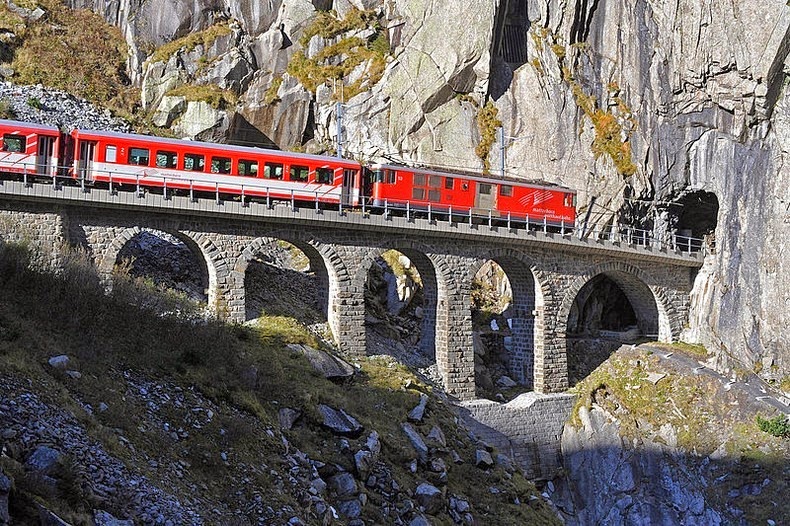
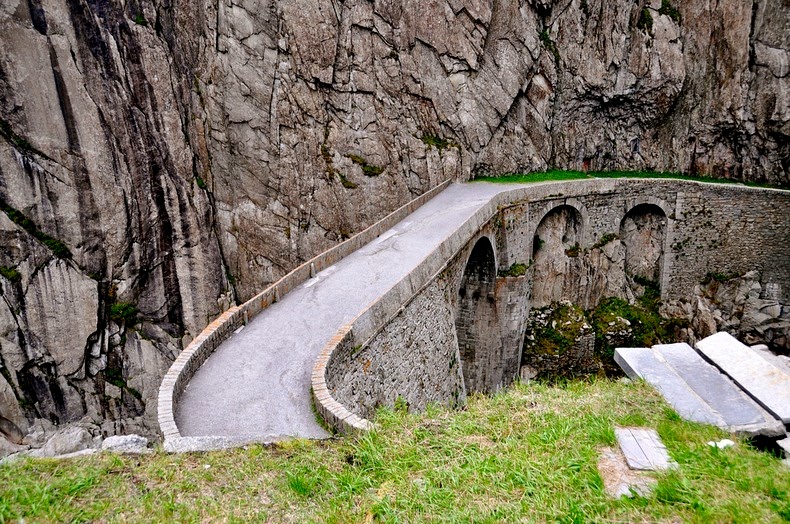
A lot of ancient bridges across Europe are referred to as the Devil’s Bridge. These bridges were built under such challenging conditions that successful completion of the bridge required a heroic effort on the part of the builders and the community, ensuring its legendary status. This particular devil’s bridge or Teufelsbrücke is located across the Schöllenen Gorge in the scenic Reuss valley in the canton of Uri, in Switzerland. According to the legend, it was so hard to build a bridge here that a desperate Swiss herdsman wished the devil would make a bridge. The devil appeared and offered to build the bridge on the condition that the soul of the first to cross would be given to him. After the bridge was built, the villagers outsmarted the devil by sending a goat across the bridge. Angered by the trick, the devil picked up a large stone in order to smash the bridge to pieces. On his way to the bridge the devil met an old woman wearing a cross, which scared the devil causing him to drop the stone and flee.
teufelsbrucke-schollenen-gorge1
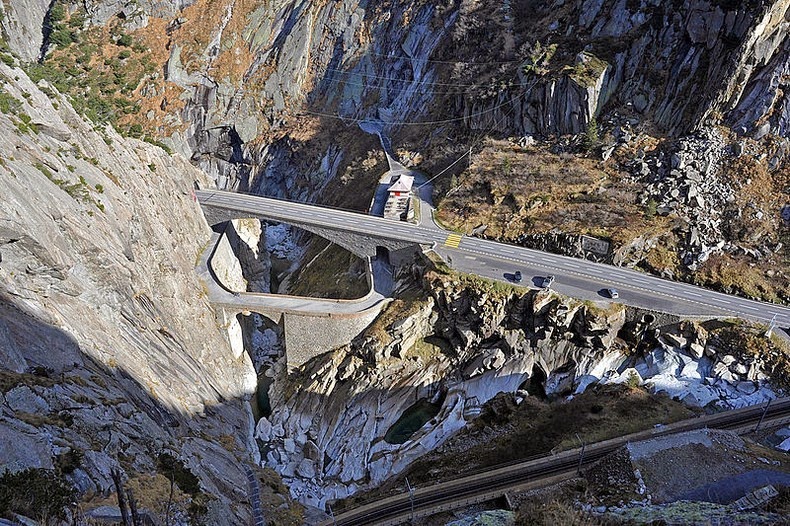
The old Devil’s bridge (below) and the new Devil’s Bridge (above) and the Matterhorn-Gotthard Railway.
The Schöllenen Gorge is an important access route and the shortest transit to the St. Gotthard Pass, but it was generally not used until the early 13th century because it involved crossing the turbulent Reuss river, swollen with snowmelt during the early summer. The first bridge across the river was built in 1230. It was a wooden bridge and needed frequent maintenance.
In the 16th century, the wooden bridge was replaced by a stone arch bridge. The road was essentially a mule track that only allowed for the transportation of goods by mule, up to the beginning of the 19th century. In 1799, this bridge witnessed one of the most dramatic battles of Suvorov's Italian and Swiss expedition which took place during the Napoleonic Wars. During this battle the bridge was heavily damaged by the retreating French army. The bridge gave away in a storm in 1888.
A new bridge was built in 1820 and it took 10 years to complete, demonstrating the difficulty of the task. By the middle of the 20th century, the second bridge was no longer able to handle the volume of traffic it received, and a concrete bridge, featuring two lanes was built in 1958 to accommodate heavier flow. The second devil's bridge still exists today but is not used.
In 1994, the Swiss government issued a commemorative coin for the Teufelsbrücke. The obverse features a stylized scene of the devil holding the devil’s stone – the Teufelsstein - approaching the bridge to smash it. The 220 ton rock, allegedly picked up by the devil, is still there, though it had to be moved by 127 meters in order to make room for the new Gotthard road tunnel.
teufelsbrucke-schollenen-gorge8
The Devil's Bridge in the Schöllenen Gorge on the Way across the St. Gotthard Pass with a Mule Train, before 1805. A painting by Swiss painter Peter Birmann (1758 - 1844).
teufelsbrucke-schollenen-gorge7
The old devil’s bridge in a 1934 picture of the Schöllenen Gorge.
teufelsbrucke-schollenen-gorge4

teufelsbrucke-schollenen-gorge2

teufelsbrucke-schollenen-gorge6
Leaning bridge of the Schöllenen railway near the devil's bridge.
teufelsbrucke-schollenen-gorge3
The old devil’s bridge 

teufelsbrucke-schollenen-gorge5

Sunday, 4 October 2015

Hussaini Suspension Bridge, The World's Most Dangerous Bridge

Hussaini suspension bridge crosses the lake Borit upstream of Hunza river in northern Pakistan. A 2,600 m altitude, in the region of Gilgit-Baltistan is the world's most dangerous bridge. It is an important point of connection of the routes that go to the north of the country, belongs to the people of Pasu and other neighboring villages and ends at the lake itself in Giglit-Baltistan. Since 1978 is relatively isolated by the lack of roads and infrastructure, the only possible way is through the mountains to Rawalpindi, or traffic of aircraft but only for the richest people, Internal insulation between regions is offset by the construction of the Karakoram Highway, which crosses the region from outside. The view from the Hussaini-Borit Lake Bridge is picturesque, not to mention precarious and potentially lethal.

Borit Lake Bridge

The six main cables are hung from one bank to another. Massive gaps between the wooden planks, Many planks are missing, and strong winds shake the bridge. It does little to ease nerves that a previous, older, broken bridge hangs in tatters next to the "new" one. It is very dangerous to cross the Borit Lake and rapidly flowing Hunza River is particularly frightening, reason for being named world’s most dangerous suspension bridge and also world's most attractive bridge. The new Hussaini hanging bridge as the tattered remains of the previous bridge still hangs next to it. The deadly poor maintenance of Hussaini Bridge is also one of the most Oldest Bridge of Pakistan.

The truly death-defying thrills and fears associated with crossing this bridge where sudden gusts of winds can  hit travelers off their feet to face to face with death. Despite its dangerous looks, however, the Hussaini is is a relatively safe bridge and has become something of a tourist draw, with hikers testing their nerves as they carefully work their way across.

picturesque Bridge; Hussaini suspension bridge; Hunza river bridge; Giglit Baltistan bridge


Hussaini suspension bridge, Passu, Pakistan
Hussaini suspension bridge, Passu - Pakistan. 

Hussaini Borit Lake Bridge


Oldest Bridge of Pakistan


world’s most dangerous suspension bridge


world's most attractive bridge


broken bridge of Pakistan


 Hussaini hanging Bridge


Hanging bridge of pakistan


The World's Most Dangerous Bridge

Monday, 28 September 2015

Beautiful and Amazing Bridges in the World

Tower Bridge, London, England
The Tower Bridge Built from 1886 till 1894, which is a symbol of London and it, is a combined bascule and suspension bridge in London, over the River Thames. It is close to the Tower of London, from which it called its name. Both the bridge and the castle next to it are one of the most visited places not only in London or England, but in all Europe and even the entire world.
Sydney Harbour Bridge, Sydney, Australia
The Sydney Harbour Bridge is steel through arch bridge across the Sydney Harbour. This amazing bridge carries roads for vehicles and railroads as well as bicycle and pedestrian traffic between the North Shore and the central business district of the city. It is a most beautiful symbol of Sydney and Australia. The bridge is nicknamed “The Coat hanger” by the local residents because the design is arch-based.
Golden Gate Bridge, San Francisco, United states
Golden Gate Bridge, San Francisco
The Golden Gate Bridge is placed in San Francisco and is perhaps the city’s most famous attraction. With the view of the bay around it, it is a truly amazing sight to see. Golden Gate Bridge is a world famous beautiful symbol of the West Coast of the United States and the most popular attraction of San Francisco has a main span of 1,280 meters (4,199 ft) which makes it around the 11th longest bridge in the world.
Millau Viaduct, Millau, France
Millau Viaduct, Millau, France 2
This 4 lanes highest amazing cable-stayed bridge that spans the valley of the River Tarn near Millau in southern France. With a structural height of 343 meters (1,125 ft) the Millau Viaduct bridge is the also tallest bridge in the world, which is opened in 2004. This bridge has 7 piers of different heights.
Akashi Kaikyō Bridge, Japan
The Akashi Kaikyō Bridge is the longest and dangerous bridge in Japan with 1,991 meters (6,532 ft) length. Opened in 1998, it has connected the city of Kobe on the mainland of Honshu to Iwaya on Awaji Island. It is also 4th tallest bridge in the world and one of the longest suspension bridges.
Great Belt Bridge, Denmark
The Great Belt Bridge is another amazing highest bridge in the World. It was opened in 1998 and connected between the Danish islands of Zealand and Funen. Its total length is 6,790 meters (22,277 ft) and max height of 254 meters (833 ft) makes it is the third longest suspension span bridge in the world and 8th tallest bridge in the world.
Brooklyn Bridge, New York, United States
Brooklyn-bridges
The Brooklyn Bridge is completed in 1883, it is one of the oldest suspension bridges in the United States. It connects Manhattan and Brooklyn by spanning the East River. It has a main span of 1,595.5 feet (486.3 m) which made its longest suspension bridge in the world from its opening until 1903. It has become one of the best icons on New York from its opening day.
The U Bein Bridge, Burma
The U Bein Bridge is almost 4,000 feet long and u turn shape. It is the longest teak bridge in the world and spans The Taugthaman Lake in Amarapura. Not wanting to throw out the teak columns during the move from the old place to Mandalay, the city’s mayor, U Bein, made a bridge out of them. Those teak columns must have been huge. This bridge is best seen at sunset, with the robed monks walking along it silhouetted in the dimming light.
Millennium Bridge, London
Millennium-Bridges, London
The Millennium Bridge is most amazing and different to other bridges. Across from the Tate Modern, the bridge to the new millennium became known as The Wobbly Bridge shortly after it opened due to a queue-inducing wobble. It was closed for the two years to undergo wobble removal.
Langkawi Sky Bridge, Malaysia
Langkawi Sky - Bridges, Malaysia
Langkawi Sky Bridge is the best solution when you’re craving a slice of Malaysian. Helicopters into place at the top of Machinchang Mountain, the footbridge provides overhead views of luscious rainforest from Langkawi’s second highest peak. You reach it by cable car, with views of the Telega Tujuh beautiful Waterfalls along this way

Sunday, 20 September 2015

THE MAGDEBURG WATER BRIDGE


The Magdeburg Water Bridge is a navigable aqueduct in Germany, opened in October 2003, that connects the Elbe-Havel Canal to the Mittelland Canal, and allows ships to cross over the Elbe River. At 918 meters, it is the longest navigable aqueduct in the world. The water bridge joined the former East and West Germany, as part of the unification project.