Brief Introduction
Beijing is the capital of the People's Republic of China, and is also China's second largest city. As one of the four municipalities under direct control of the Central Government, Beijing is a political, transportation and cultural center. Integrating Chinese cultural symbols from the Yuan, Ming and Qing Dynasties, Beijing boasts various historic relics and cultural landscapes, as well as the largest number of World Cultural Heritage sites. In 2010, Beijing was listed as the world's 15th largest metropolitan area, holding the highest position among all of the cities in mainland China.
Reasons for Recommendation
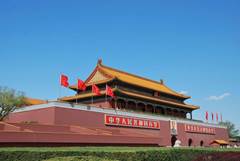
If you want to explore an ancient China, come to Beijing; if you want to explore a modern China, also come to Beijing. Pictures posted by Sen Qing and Li Ziyi.
Travel Information
Other name: Peking
Climate features: warm temperate zone, continental monsoon climate
Language: Mandarin, Beijing local dialect
Telephone code: 86 (country code) / 010 (area code)
Postal code: 100000
Location: At the northwest periphery of the North China Plain, near Bohai Bay, Beijing lies south of Liaodong Peninsula and north of Shandong Peninsula.
Emergency numbers: police 110; first aid 120; fire 119
Currency: Renminbi (RMB)
Exchange rate: 1 U.S. dollar = 6.65 RMB, 1 Euro = 8.81 RMB (for reference only)
Tourist Attractions
1. The Forbidden City
General information:
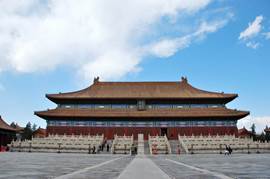
The Forbidden City was the imperial palace complex where the emperors lived and worked during their reigns. It is now known as the Palace Museum in Beijing. Lying at the very heart of Beijing, the Forbidden City was home to 24 emperors of the Ming and Qing Dynasties. Construction of the palace complex began when Zhu Di, a Ming Dynasty emperor, moved the capital to Beijing and stopped in 1420, during the 18th year of the Yongle Reign of the Ming Dynasty. The Forbidden City is not only a masterpiece of ancient Chinese architecture, but also the largest and best preserved wooden ancient structure.
Location:
Located at the center of the central axis of Beijing
2. The Great Wall
General information:
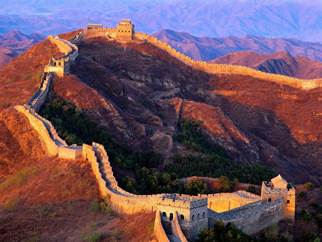
The Great Wall is the collective name for a series of military fortifications built at different times to protect the borders of ancient China against invasions. Stretching from east to west for over 5,000 kilometers (10,000 Li), it is also called Ten-Thousand-Li Great Wall. The Great Wall as it exists today was built in the 14th century during the Ming Dynasty. The Badaling Great Wall, located in Beijing's Yanqing County, is a typical section of the Great Wall built during the Ming Dynasty. The Badaling Great Wall reaches up to 1,015 meters above sea level. It served as the outpost for Juyong Pass, which was an important military pass and a critical barrier protecting the capital city of Beijing during the Ming Dynasty.
Location:
Located at the north intersection of Guangou Ancient Road and Jundu Mountain in Yanqing County
3. Tian'anmen Gate
General information:
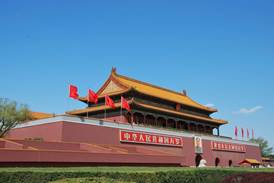
Tian'anmen Gate was the principal entrance to the Imperial Palace during the Ming and Qing Dynasties. Built in 1420, it was officially named Tian'anmen Gate in 1651. On October 1, 1949, the founding ceremony for the People's Republic of China was held here. Tian'anmen Gate is also incorporated into the national emblem as the symbol of modern China. As a result, Tian'anmen Gate is venerated as a place of special honor by the Chinese people.
Location:
Located at the center of the central axis of Beijing, facing Chang'an Street
4. The Summer Palace
General Information:
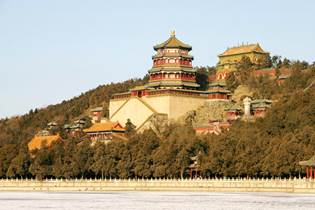
The Summer Palace is the largest and best preserved royal garden in existence, and one of China's Top Four Famous Gardens. Built on Kunming Lake and Longevity Hill, the Summer Palace is a large park with a natural lake and hill, built to resemble the scenery of West Lake in Hangzhou and incorporating the designs and artistic concepts of the gardens of the southern Yangtze River. It is also the best preserved imperial park and is known as the imperial park museum.
Location:
Located to the west of Yuanmingyuan Ruins, Haidian District, 15 kilometers from downtown
Local Transportation
1. Subway
Beijing's subway network is extensive and covers the urban and suburban areas with 14 lines, including Line No.1, No.2, No.4, No.5, No.8, No.10, No.13, No.15, Batong Line, Yizhuang Line, Daxing Line, Fangshan Line, Changping Line and the Airport Express. Except for the Airport Express, subway tickets for travel throughout the system cost RMB 2 yuan per person.
2. Bus
Beijing's bus network consists of 900 to 1,000 bus lines, which operate electric buses, air-conditioned buses and double-decker buses.
3. Taxi
In Beijing, the daytime flag-down fare is RMB 10 yuan for the first 3 kilometers, with an additional RMB 2 yuan per kilometer charge for distances up to 15 kilometers. The charge increases to RMB 3 yuan per kilometer for distances exceeding 15 kilometers.
At night (11PM - 5AM), the flag-down fare is RMB 11 yuan for the first three kilometers, with an additional RMB 2.4 yuan per kilometer charge for distances up to 15 kilometers and RMB 3.4 yuan per kilometer if the trip exceeds 15 kilometers.
As of November 25, 2009, a fuel surcharge of RMB 2 is added to the taxi fare shown on the meter for all trips exceeding three kilometers.
Climate
Located in the transition zone between mountain and plain, Beijing features a temperate, continental monsoon climate characterized by four distinct seasons.
Spring: dry, short days
Summer: high temperatures, humid, rainy
Autumn: blue sky, crisp air, well suited for travel
Winter: cold, dry, sometimes sandy wind
The best seasons for travel are from the second half of April to the first half of June, and from the second half of August to the end of November.


No comments:
Post a Comment